
 January 10, 2026
Artificial Intelligence is no longer the exclusive domain of large enterprises or tech giants. By 2026, mid-tier companies—those operating between startups and large corporations—are emerging as the most active adopters of AI. Unlike early experimentation phases, AI adoption in this segment is now becoming practical, outcome-driven, and deeply embedded into daily operations.
For mid-tier organizations, the focus is no longer on exploring what AI can do, but on how AI can deliver measurable business value. The AI adoption trends shaping 2026 reflect this shift toward execution, governance, and leadership accountability.
Below are the key AI adoption trends defining how mid-tier companies are implementing AI in 2026.
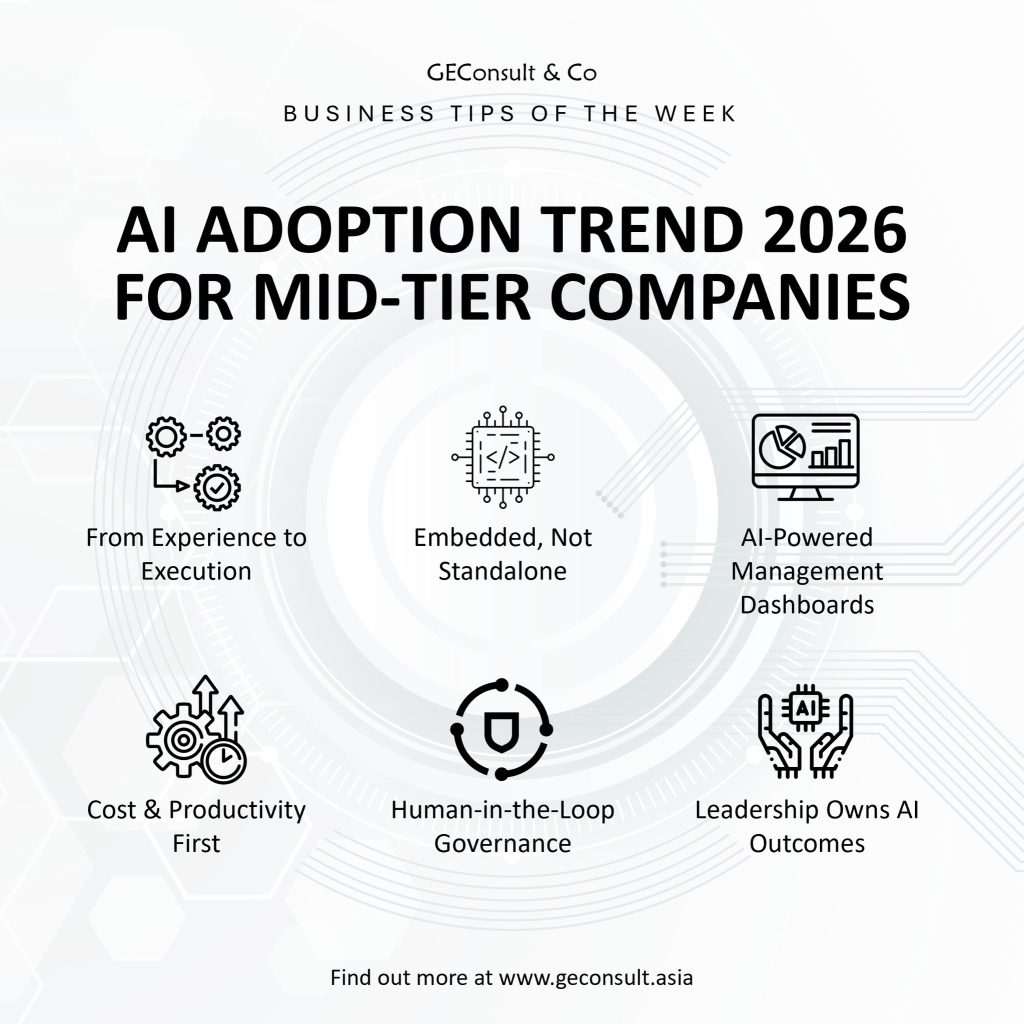
From Experience to Execution
In previous years, many organizations experimented with AI through pilots, proofs of concept, or isolated tools. In 2026, mid-tier companies are moving decisively from experimentation to execution.
AI initiatives are now tied directly to operational KPIs such as cost reduction, revenue growth, customer satisfaction, and cycle-time improvement. Instead of running parallel AI experiments, companies are integrating AI into existing workflows—sales operations, customer support, finance, procurement, and HR.
This shift reflects a more mature mindset: AI is no longer a side project driven by innovation teams but a core business capability aligned with strategy and execution.
Embedded, Not Standalone AI
One of the most defining trends of AI adoption in 2026 is that AI is becoming embedded rather than standalone.
Mid-tier companies are no longer investing in separate AI platforms that operate in silos. Instead, AI capabilities are being integrated directly into existing enterprise systems such as ERP, CRM, marketing automation tools, and supply chain platforms.
This embedded approach reduces complexity, lowers adoption resistance among employees, and accelerates ROI. Employees interact with AI seamlessly as part of their daily tools—often without realizing they are using AI at all.
Embedded AI ensures that intelligence flows naturally across the organization, rather than being confined to specialized teams.
AI-Powered Management Dashboards
In 2026, decision-making is increasingly driven by AI-powered management dashboards. For mid-tier companies, these dashboards act as a central nervous system, transforming raw data into actionable insights.
AI-driven dashboards go beyond static reporting. They provide predictive insights, anomaly detection, and real-time recommendations. Leaders can monitor performance across departments, forecast risks, and simulate outcomes before making decisions.
This trend empowers management teams to move from reactive reporting to proactive decision-making, enabling faster responses in competitive and volatile markets.
Cost & Productivity First
Unlike large enterprises that may invest heavily in long-term AI research, mid-tier companies adopt AI with a cost and productivity-first mindset.
In 2026, the most successful AI initiatives are those that:
- Reduce operational costs
- Improve employee productivity
- Automate repetitive tasks
- Shorten turnaround times
AI is widely used for customer support automation, invoice processing, demand forecasting, workforce scheduling, and internal reporting. These use cases deliver fast, tangible returns and justify further AI investments.
For mid-tier companies operating with tighter budgets, AI adoption is driven by efficiency gains, not hype.
Human-in-the-Loop Governance
As AI becomes embedded in critical business processes, governance takes center stage. In 2026, mid-tier companies are prioritizing human-in-the-loop governance models.
Rather than fully autonomous systems, AI is designed to support human decision-makers. Humans retain oversight, validate outputs, and intervene when necessary. This approach ensures accountability, reduces operational risk, and builds trust in AI systems.
Human-in-the-loop governance is especially important in areas such as finance, compliance, hiring, and customer interactions—where errors can have significant consequences.
This trend reflects a balanced approach: leveraging AI’s speed and intelligence while preserving human judgment.
Leadership Owns AI Outcomes
Perhaps the most important shift in AI adoption for mid-tier companies in 2026 is leadership ownership.
AI is no longer delegated solely to IT or data teams. Business leaders—CEOs, COOs, CFOs, and department heads—are accountable for AI outcomes. They are expected to understand how AI impacts strategy, performance, and risk.
This leadership-driven adoption ensures that AI investments are aligned with business priorities rather than technology trends. It also accelerates organizational adoption, as employees see AI initiatives backed by top management.
When leadership owns AI outcomes, AI becomes a strategic asset rather than a technical experiment.
What This Means for Mid-Tier Companies
The AI adoption trends of 2026 clearly show that mid-tier companies are entering a new phase of maturity. Success is no longer defined by who adopts AI first, but by who adopts AI correctly.
Companies that embed AI into operations, focus on productivity, maintain strong governance, and assign leadership accountability will gain a lasting competitive advantage.
For mid-tier organizations, AI in 2026 is not about transformation for its own sake—it is about sustainable, scalable, and responsible growth.
Conclusion
AI adoption in 2026 marks a turning point for mid-tier companies. The shift from experimentation to execution, from standalone tools to embedded intelligence, and from technical ownership to leadership accountability defines this new era.
By focusing on cost efficiency, productivity gains, governance, and outcome-driven implementation, mid-tier companies can harness AI as a powerful enabler of business performance.
Organizations that align their AI strategy with these trends will not only stay competitive—but lead confidently into the future.