
 February 19, 2026
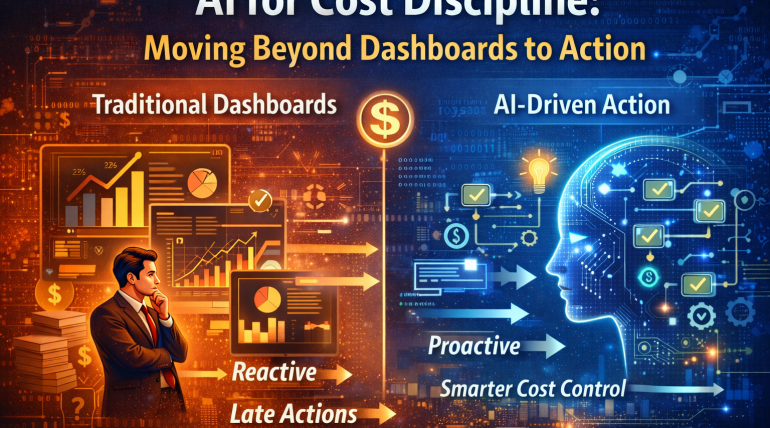
In today’s volatile business environment, cost discipline is no longer optional — it’s fundamental to survival and growth. Organizations invest heavily in analytics, business intelligence tools, and dashboards to monitor financial performance. Yet despite all that visibility, many companies struggle to translate insights into sustained cost action and control.
This gap exists not because of lack of data, but because cost discipline isn’t just a reporting challenge — it’s a decision and action challenge. At GE Consult Asia, we believe that organizations must move beyond dashboards and embrace intelligent, actionable frameworks powered by AI — not merely to see costs, but to control and reduce them.
Why Cost Discipline Is Hard — Even With Dashboards
Dashboards have become ubiquitous. Almost every organization now has tools that visualize expenses, budget variances, unit economics, and operational metrics. These platforms are useful — but they often create false confidence. Leaders look at charts and heatmaps and feel they have a handle on costs. But visibility alone does not change behavior.
There are three core reasons dashboards fail to drive cost discipline:
- Passive Visibility
Dashboards show what has happened, not what needs to happen. They are historical or descriptive, not prescriptive. - Delayed Action
Insights often arrive too late. When decision-makers finally spot overspending, budgets have already been blown, and the window for corrective action has narrowed. - Disconnected Accountability
Seeing a cost overrun doesn’t automatically clarify who should act, how, or when.
In short, dashboards describe problems — but do not by themselves solve them. At GE Consult Asia, we call this the “visibility paradox”: more insight without direct linkages to action often leads to more confusion, not less.
From Visibility to Action: The Role of AI
Artificial Intelligence is sometimes seen as a magic wand — but the real potential of AI is not in making prettier dashboards. It is in enabling faster, smarter, and more disciplined decisions that lead to action. AI can transform cost management from a reactive exercise into a proactive discipline.
Here’s how.
1. Predictive Cost Forecasting That Drives Proactive Control
Traditional dashboards show cost trends — for example, how spend compares to budget. AI, however, can predict future cost behavior by analyzing patterns and drivers such as seasonality, demand signals, supplier performance, or input price fluctuations.
Rather than just seeing that a cost line is rising, AI can forecast where costs are headed next month, next quarter, or next year. This gives organizations the opportunity to act before overruns occur — not after.
By bringing predictive insights into planning cycles, leaders at GE Consult Asia–supported organizations can shift budgeting from hindsight to foresight.
2. Automated Anomaly Detection That Pins Down Cost Risk
Human analysts monitor some KPIs, but complex cost structures generate thousands of signals. Manual review is slow and error-prone. AI excels at detecting anomalies, such as unexpected spikes in spend categories, supplier billing errors, or deviations from contractual terms.
AI systems can monitor cost data in real time, flag unusual patterns, and even assign severity scores based on potential financial impact. These alerts are not generic but tailored to risk profiles, enabling organizations to prioritize attention where it matters most.
At GE Consult Asia, we help clients integrate anomaly detection with accountability frameworks so that alerts automatically trigger workflows — escalating to the right role with context and recommended next steps.
3. Root Cause Insights That Go Beyond the Numbers
Understanding that costs have increased is only the first step — effective cost discipline requires knowing why. AI tools can identify hidden cost drivers by correlating disparate datasets: production volumes, workforce hours, supplier lead times, logistics delays, customer demand changes, and more.
This capability enables more precise interventions. For example, instead of just cutting a budget line, leaders can identify inefficiencies like underutilized assets, supply chain delays that inflate logistics spend, or misaligned incentives that drive unnecessary overtime.
AI uncovers patterns that might take human analysts months to find — and does it continuously and at scale.
4. Prescriptive Recommendations That Close the Loop
The real power of AI lies in prescriptive insights: recommendations about what actions to take. Rather than simply informing decision-makers that costs are trending upward, AI can suggest specific actions such as:
- renegotiating with underperforming suppliers,
- automating routine transactions to reduce labor cost,
- adjusting production schedules to balance capacity and demand,
- optimizing inventory levels to reduce holding costs,
- identifying low-value expenditures for targeted reduction.
By embedding prescriptive analytics into operational processes, organizations can move beyond reporting and into cost discipline that drives results — something that leaders at GE Consult Asia consistently advocate and implement.
5. Continuous Learning and Feedback Loops
AI systems continually learn from outcomes. When an organization takes action — such as optimizing logistics routes — AI can evaluate the results and adjust future recommendations. This creates a feedback loop that improves decision quality over time.
Instead of one-off optimization, organizations build adaptive cost governance — where actions, results, and insights form a virtuous cycle of improvement.
Embedding Action Into Business Processes
AI’s value is fully realized only when it is tightly embedded into how organizations actually work. That means connecting AI insights directly to workflows like:
- procurement approvals,
- budget reviews,
- workforce planning,
- contract management,
- expense reporting.
At GE Consult Asia, we emphasize that AI shouldn’t live in a separate analytics silo. Instead, it must be integrated with enterprise processes so that insights become default triggers for action rather than optional signals.
Here’s what integration looks like in practice:
- An AI system detects an impending cost overrun in marketing campaigns and automatically routes a recommendation to the marketing controller with suggested adjustments.
- An anomaly detection model highlights a spike in supplier charges and auto-initiates an investigation workflow with audit-ready evidence.
- A predictive model flags inventory obsolescence risk and recommends timing for markdowns or clearance to procurement and sales teams.
These are not theoretical possibilities — they are practical implementations that move organizations from dashboard watching to decisive cost action.
The Human-AI Partnership
Despite AI’s power, cost discipline remains a human-centric challenge. AI recommends, but humans decide — especially in strategic or nuanced scenarios. The key is to create decision frameworks where humans and machines collaborate effectively:
- humans provide context and judgment,
- AI provides insight and speed,
- governance ensures accountability,
- and processes link insight to execution.
This synergy accelerates cost discipline in a way that dashboards alone never could.
GE Consult Asia’s Approach to AI-Powered Cost Discipline
At GE Consult Asia, we help organizations implement cost discipline frameworks that:
- Define clear cost management goals and decisions,
- Integrate and clean data across finance, operations, and supply chain,
- Deploy predictive and anomaly-detection models tailored to cost drivers,
- Embed prescriptive recommendations into decision workflows,
- Establish feedback loops for continuous improvement,
- Build governance structures that ensure accountability and action.
Rather than selling technology, we help organizations embed intelligence into how decisions are made and executed — ensuring that insights translate into measurable financial results.
Conclusion: Cost Discipline Is a Journey, Not a Dashboard
Building cost discipline is not about having the most colorful charts or the most advanced BI tool. It’s about using AI to shift from passive monitoring to active, continuous cost governance.
Organizations that simply install dashboards will continue to react after the fact. Those who embrace AI as part of an action-oriented framework — with clear accountability, embedded workflows, and intelligent automation — will achieve sustainable cost control and competitive advantage.
At GE Consult Asia, we believe AI should be a catalyst — not a decoration. When deployed with purpose, AI transforms cost discipline from an aspiration into a strategic operational capability.
If your organization is ready to move beyond dashboards to real cost action, the future of disciplined, intelligent performance begins now.