
 February 12, 2026
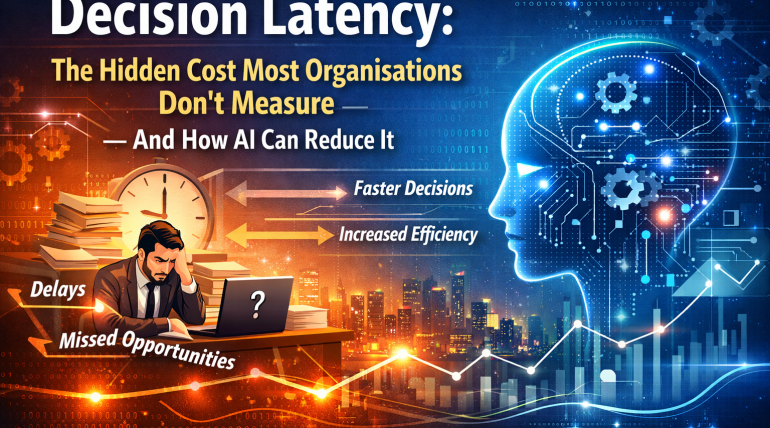
In an age where data is abundant and analytics tools are powerful, most organizations proudly proclaim themselves “data driven.” Yet even with dashboards, reporting platforms, and analytics teams, many companies still struggle to convert insights into timely actions. The reason isn’t a shortage of data — it’s decision latency: the hidden cost that quietly drains value from every part of a business, yet rarely appears on balance sheets or performance scorecards.
What Is Decision Latency — And Why It Matters
Decision latency refers to the time between when an important signal — like a market shift, anomaly, or operational alert — becomes visible, and when an actual decision and corresponding action take place. It’s not just about delayed responses; it’s about lost opportunities, frozen capital, competitive erosion, and risk that compounds silently.
Consider this simple timeline:
A disruption occurs → data becomes available → someone interprets it → decisions are debated → approvals are sought → actions are implemented.
Every millisecond or minute added between these steps is a tax on efficiency — a tax that conventional reporting systems aren’t designed to measure.
The problem is that most organisations track what has already happened — not how quickly they act on it. They measure throughput, forecast accuracy or cost per unit, but they don’t measure how much value slips away because decisions lag. The impact? stagnating growth, wasted resources, lower customer satisfaction, and reduced competitiveness.
The Invisible Tax: Why Latency Costs More Than You Think
Decision latency hides under the surface of everyday operations. It rarely shows up as an obvious headline cost — but the consequences are real:
- Missed opportunities: Competitors that act faster capture market share or customer mindshare.
- Margin erosion: Old insights lead to outdated decisions — and that costs money.
- Operational waste: Teams spend hours refining reports, attending meetings, and waiting for approvals rather than acting.
- Risk amplification: In dynamic environments like supply chains, delays turn small issues into cascading failures.
One blog estimates the so-called “latency tax” — the money lost while operators interpret dashboards instead of acting — can easily add up to tens of thousands of dollars per incident, depending on industry and scale.
In supply chains, for example, delays in seeing demand changes or supplier disruptions can result in stockouts, excess inventory, or logistic bottlenecks. In financial services, a lag in underwriting decisions can mean higher risk or lost deals. In manufacturing, it can mean delayed corrective actions that push up downtime. These are not academic numbers — they are real costs hidden in decision cycles.
Why Traditional Tools Fail to Eliminate Latency
Most tools in the modern enterprise focus on visibility:
- Dashboards show trends.
- Reports summarize performance.
- Alerts notify stakeholders.
But visibility alone doesn’t guarantee speed of action. At best, traditional analytics reduce the time it takes for people to see data. They do not eliminate the time it takes to act on it. In other words, dashboards increase information — but they often increase decision latency because humans are still responsible for interpretation and next steps.
Decision latency is not caused by slow people — it’s caused by systemic delays in how organizations process information, make choices, and initiate action. Things like siloed data systems, manual approvals, unclear delegation, and outdated governance structures all contribute to it.
Making Latency Measurable: The First Step to Solving It
The challenge with decision latency is that it’s invisible in most performance frameworks. Organizations often assume that once data arrives, decisions follow promptly. But this assumption overlooks multiple types of delays:
- Demand latency – waiting too long to recognize changes in customer or market behavior.
- Planning latency – slow adaptation of plans to new data.
- Execution latency – delays between planning a change and putting it into action.
Organizations that want to address decision latency must start by measuring it — and that requires tracking outcomes like:
- Time between signal detection and decision.
- Time between decision and execution.
- Frequency and duration of approval overhead.
- Lost opportunities due to delayed responses.
Mapping decision workflows and timing every step reveals bottlenecks that traditional performance metrics ignore.
How AI Shrinks the Gap Between Insight and Action
Artificial Intelligence (AI) has emerged as a powerful antidote to decision latency. But it’s important to understand that AI’s value isn’t just in producing better predictions — it’s in accelerating the entire decision lifecycle.
Here’s how AI can reduce decision latency:
1. Real-Time Signal Detection
AI systems can ingest and analyze streaming data, ensuring that signals are detected immediately rather than waiting for batch processing. This eliminates the delay between data availability and awareness.
2. Contextual Interpretation
Instead of leaving interpretation to humans combing through reports, AI models can contextualize data, highlight anomalies, and assess risk in real time — cutting out cognitive delays.
3. Actionable Recommendations
Advanced decision systems don’t just report: they prescribe. By providing clear next steps, AI helps decision-makers act immediately rather than waiting for meetings or consensus.
4. Automated Execution
In some cases, AI can automate low-risk decisions entirely — such as inventory reorder triggers, pricing adjustments, or compliance rulings — effectively eliminating human lag for routine actions.
5. Continuous Learning
Modern systems adapt — learning from past decisions, refining models, and improving future performance, reducing hesitation and required validation.
In essence, the organizations that win are those that use AI not just as a reporting tool, but as an operational decision engine that shortens the latency between sensing a condition and acting on it.
Organizational Change Must Accompany Technology
While technology — especially AI — has a central role in reducing latency, it doesn’t work alone. Organizations must also:
- Clarify decision ownership — reduce ambiguity about who should act.
- Flatten approval layers — empower teams to make decisions with clear guardrails.
- Integrate systems — break down data silos so information flows freely.
- Redesign processes — streamline workflows to eliminate unnecessary handoffs.
In many cases, decision latency is as much a cultural challenge as it is a technological one. Risk-averse habits, fear of accountability, and bureaucratic inertia all extend the time it takes to act. Addressing these requires leadership commitment and governance that prioritizes speed and agility.
The Competitive Edge of Reduced Latency
Reducing decision latency isn’t just an efficiency play — it’s a strategic advantage. In volatile markets, the ability to sense change and respond faster than competitors can be the difference between growth and decline. As industries become increasingly interconnected and fast-moving, the cost of latency rises.
Companies that embrace decision-centric systems benefit in multiple ways:
- Faster time-to-value from data investments.
- Reduced operational waste and better resource utilization.
- Enhanced risk management through rapid response.
- Improved competitive positioning in dynamic environments.
Conclusion: The Time to Act Is Now
Decision latency is the hidden cost that traditional reporting, dashboards, and analytics fail to capture. It’s a silent drag on performance that influences outcomes more than most organisations realize. But it’s also fixable — if leaders measure it, understand its sources, and leverage AI to close the gap between insight and action.